



Sophia Agathocleous – Research
Andreas Andreou – Research
Theophile Bloudanis – Research and editorial oversight
In summary: Visegrád 24 combined the display of ‘Free Cyprus’ graffiti with political statements on Cyprus and criticism of pro-Palestinian demonstrations. Its involvement with Cyprus, however, has been documented since as early as 2020. We identified identical messages and evidence of the reuse of online identities on the accounts that reproduced the slogan. These findings are consistent with possible coordinated activity. However, there is no evidence of joint control of these accounts, their involvement in the creation of the visual material, or their coordination with Visegrád 24. The media outlet has a conservative and pro-Israeli stance and is supported by the US-based Intermarium Foundation. Public records make it possible to trace certain funding routes, without revealing the original donors behind much of the funding or linking a specific donor to the coverage of the Cyprus issue.
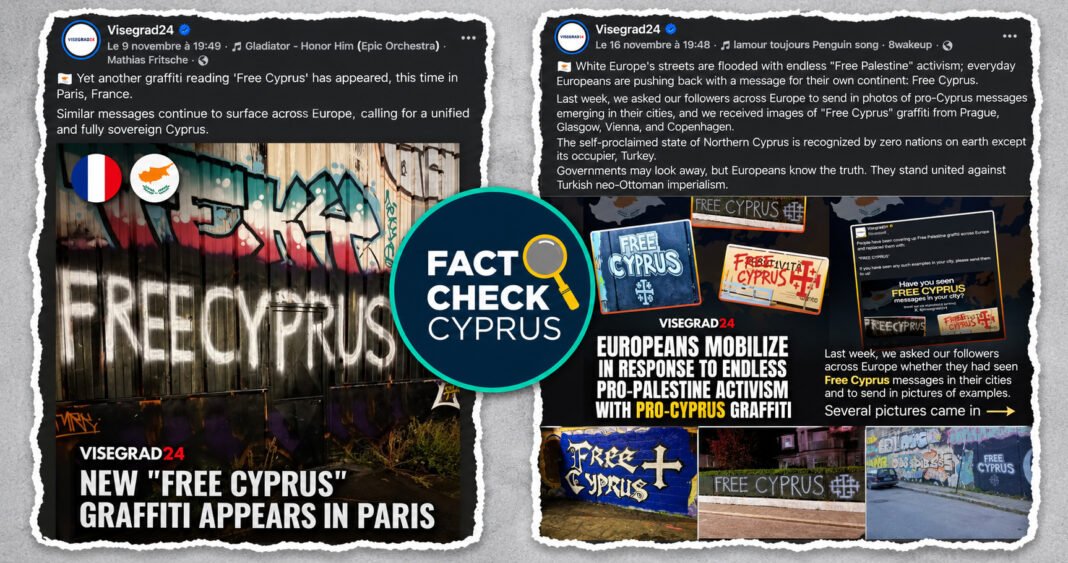
In early November 2026, the account ‘Visegrád 24’, with nearly 2.1 million followers on X, published a series of photographs, videos and comments regarding ‘Free Cyprus’ graffiti that had allegedly appeared in European cities. The outlet claims that the slogan is appearing with increasing frequency and is now “rivalling” ‘Free Palestine’.
Specifically, from 9 November 2026, Visegrád 24 began posting images of ‘Free Cyprus’ graffiti on walls in European cities across its accounts on multiple platforms (namely Facebook, X and Instagram). These include a photograph reportedly taken in Paris. On 10 November 2026, another post followed, featuring similar graffiti in Munich. On 11 November Visegrád 24 also published a video, presented as having been filmed in Edinburgh, showing a person covering up a ‘Free Palestine’ graffiti tag and writing ‘Free Cyprus’ in its place.
This series is also accompanied by posts on the Cyprus issue. Cyprus remains divided following the Turkish invasion of 1974, with the northern part of the island under Turkish occupation. On 15 November 2026, on X, Visegrád 24 responded directly to the President of Turkey, Recep Tayyip Erdoğan, writing: “It’s time to free Cyprus!”. On the same day, the media outlet published a lengthy article on Facebook to mark the 43rd anniversary of the unilateral declaration of the ‘Turkish Republic of Northern Cyprus’. In it, it refers, amongst other things, to the events of 1974, the displacement of populations, and the division of the island.
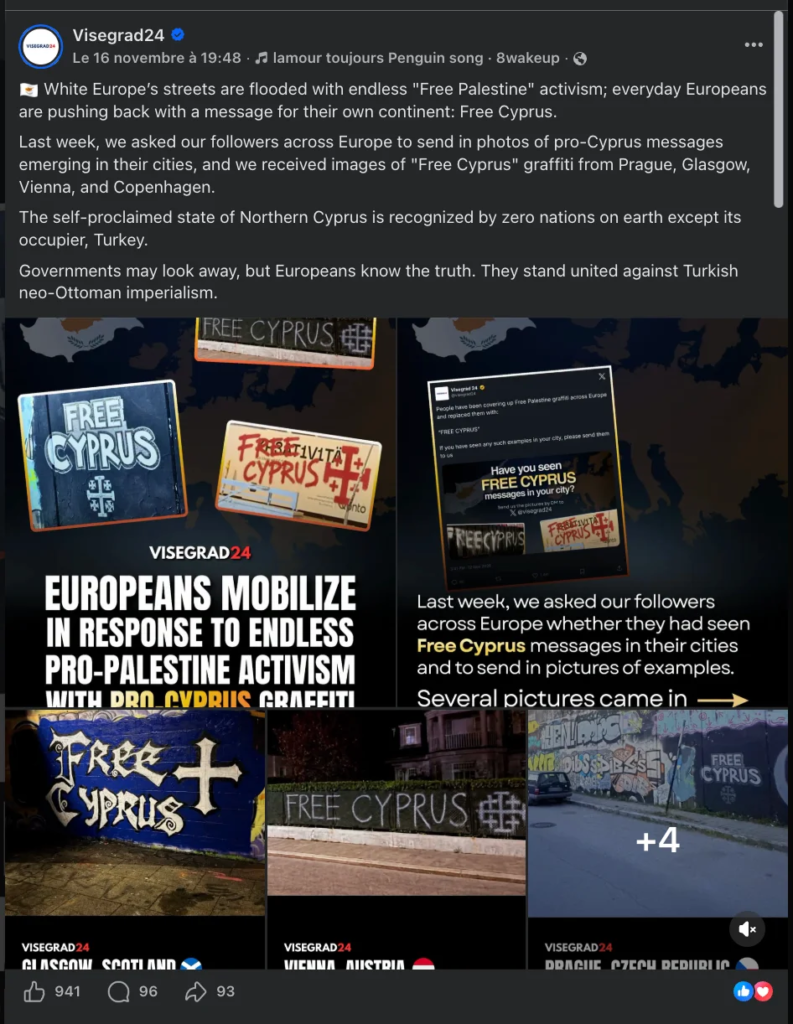
On 16 November 2026, Visegrád 24 claimed on Facebook that it had received new photographs of ‘Free Cyprus’ graffiti, having previously called on its followers to send it images of similar graffiti from their cities. According to the report, the new images come from Prague, Glasgow, Vienna and Copenhagen. In this post, the media outlet presents the messages as a reaction by Europeans to the ‘Free Palestine’ demonstrations and as an expression of opposition to what it describes as ‘Turkish neo-Ottoman imperialism’.
In another Facebook post, on 17 November 2026, the account continued to draw a comparison between the Cypriot and Palestinian issues. Referring to Turkey’s occupation of part of Cyprus, it criticises the European Left and activists such as Greta Thunberg for campaigning in support of Palestine whilst, in its view, remaining silent on Cyprus. The circulation of these graffiti images is thus part of a wider range of uses of this medium in relation to the Cyprus issue and pro-Palestinian demonstrations.
In a previous article, we examined the photograph showing the alleged ‘Free Cyprus’ graffiti in Munich, which was published by Visegrád 24. Our investigation revealed that this particular graffiti appears to have been digitally added to the image. Continuing our investigation, we turned our attention to the media outlet’s intense focus on the Cyprus issue in November, seeking publicly available information on its operations and presence on social media. We also examined how posts about the ‘Free Cyprus’ graffiti were shared, as well as its posts on Cyprus more generally.
The circulation of ‘Free Cyprus’ images on social media
After analysing the photograph from Munich, we examined the spread of posts bearing the slogan ‘Free Cyprus’. The data we gathered enable us to reconstruct part of the chain of reproduction and to identify signs of coordination between certain accounts.
In the samples we examined on X, Facebook and Instagram, the earliest posts we found relating to the material attributed to Paris, Munich and Edinburgh originated from Visegrád 24 and date from between 9 and 11 November 2026. The reposts on the other platforms were published after the posts on X. The account does not, however, specify who sent it the photographs and the video.
On 12 November 2026, Visegrád 24 asked its followers to send it photographs of ‘Free Cyprus’ messages they spotted in their town. A graphic invites them to send the images via private message. This appeal, however, provides no information about the origin of the photographs and the video it had already posted over the previous three days.
On 13 November, the account posted two new images purportedly taken in Ghent, Belgium, and Ikaria, Greece. The first shows a marker pen inscription on the inside of a train window, next to a sticker bearing the Belgian Railways logo. This detail alone is not sufficient to place the scene in Ghent. The second shows the words «ΛΕΥΤΕΡΙΑ ΣΤΗΝ ΚΥΠΡΟ», or “FREEDOM FOR CYPRUS”, on a section of wall covered in white paint. We were unable to identify the specific wall with certainty.
Reports of these new locations were reproduced by, amongst others, SigmaLive on 14 November (archived article here). The Greek City Times also describes the photograph attributed to Ikaria (archived article here), without giving a specific address or identifying its creator. During the review on 16 November, a photograph was also identified which had been posted on 13 November by the @ItsMeAgisPh account on X and is claimed to have been taken in Gythio, Greece.
Visual material varying in nature and reliability
The material associated with the slogan does not necessarily depict new graffiti. The investigation revealed posters with activist content, emblems, photomontages and the reuse of images that had already been circulated. An image bearing the inscription ‘Free Cyprus Movement’ is circulating on various accounts, such as @AmichaiChikli, the account of Amichai Chikli, Israel’s Minister for Diaspora Affairs and the Fight Against Antisemitism.
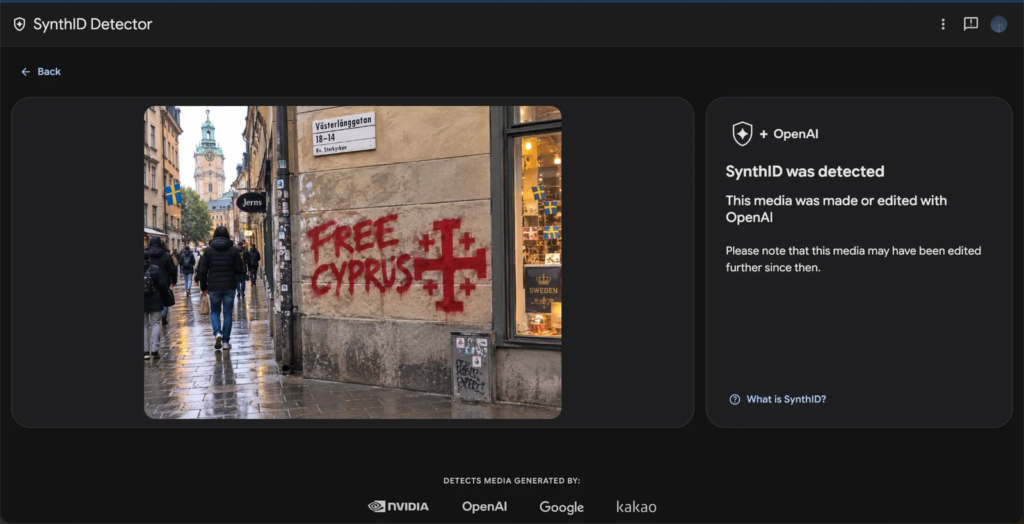
An image purportedly taken in Stockholm and posted by @cryprocosmos on 12 November, in reply to Visegrád 24, features red letters and a cross that bear a striking resemblance to those in the Munich photograph. To examine it further, we used the SynthID Detector tool. The result of the check, as shown in the screenshot below, attributes the image to OpenAI tools.
In the data we collected on responses and reposts featuring the Munich post, we did not observe any particularly concentrated spike in activity over a specific period, extensive overlap of accounts across the main reposting chains, or a predominance of newly created accounts. These findings are not sufficient either to prove or rule out the amplification of the spread through paid, automated or coordinated actions.
Identical messages and questions regarding the authenticity of the accounts
The analysis reveals, however, a group of accounts that express support for Israel and reproduce identical or very similar texts. The same wording appears, amongst others, in posts by @Jewis_Jew on 10 November 2026 and @oliviakelly62 on 11 November 2026: ‘Turks will be quiet about this one lol. Free Cyprus’. The two accounts have over 2,700 and 2,200 followers respectively. The same wording can also be found on the accounts @Lewis_Lew10 (1,600 followers) and @Tamarshalev86 (290 followers). On all four accounts, the message is accompanied by the graphic ‘Free Cyprus Movement’.
The similarities are not limited to this particular post about Cyprus. Posts on other topics are also being reposted by accounts such as @Tal7yvwr (4,700 followers), @waifu_natalia (suspended account), @oliviakelly62 and @Tamarshalev86. The reposts do not follow a single direction: different accounts reuse each other’s posts. @Jewis_Jew and @Lewis_Lew10 also post similar messages within a very short time of one another.
Our analysis also revealed peculiarities in the profiles of several accounts. The profile picture for @oliviakelly62 is taken from a screenshot of another profile, in which parts of that profile’s username and description remain visible. The same online identity first appears under the name @oliviakelly91 and then on the older account @oliviakelly62, following the last activity we observed on the former. This finding suggests the possible reuse of an online identity, without proving who controlled the two accounts.
Other profiles use similar descriptions, publish a series of posts in quick succession, or claim military affiliations or connections that have not been verified. The @waifu_natalia profile specifically states that the main account has been suspended. The screenshots below show the profile pictures of the accounts we examined:

Overall, the repetitive text and indications of reused identities are consistent with coordinated activity that may not be genuine. However, this interpretation does not amount to proof that the accounts are under common control. Genuine supporters may also copy popular posts, whilst the available evidence does not allow for the identification of any administrator or instigator.
Some of these posts had previously appeared on @HuntersOfNazis, which has over 86,000 followers, as well as on @yonatanariel68 and @Elad555Zarad, which have 3,000 and 1,900 followers respectively. Some of these statements are even recycled weeks later as ‘breaking news’.
We also examined similarities between posts by @HuntersOfNazis and translations published by @ACOM_es, the account of the Spanish association Acción y Comunicación Sobre Oriente Medio, which has over 124,000 followers. The association is registered in the CNMC’s register of interest groups (archived page here), where it states, amongst other things, that it promotes relations between Spain and Israel and publishes translations. It cannot be ruled out that the messages compared may have originated from a common source. The evidence examined does not, however, substantiate any coordination between ACOM and the group, nor its involvement in disseminating the image of the graffiti or the specific wording regarding Cyprus.
These specific accounts on X continue to post and repost each other’s content. However, our monitoring of the period from 12 to 16 November did not reveal any new posts regarding Cyprus. The reposting of content on other topics continues, particularly between @Tamarshalev86 and @oliviakelly62, as well as between @Jewis_Jew and @Lewis_Lew10.
In this particular sample, the group reposted the message ‘Free Cyprus’ from 10 to 12 November, with no further mention of the issue observed in the subsequent monitoring. The limited scope of the data collection does not allow us to rule out posts that may have been missed, nor to conclude with certainty that these accounts are running an ongoing campaign regarding Cyprus.
These findings relate to the behaviour of specific accounts and do not substantiate any organisational link with Visegrád 24. To place the dissemination of these posts in its broader context, we also examined the public identity, activities and funding of the media outlet itself.
What we know about Visegrád 24
Visegrád 24 was founded in 2020 and, on its website, describes itself as a “leading international news outlet”. Stefan Tompson has spoken publicly about his role as the account’s founder and administrator. In an interview with Le Monde, he describes a project that covers international issues such as migration and the wars in Ukraine and the Middle East with a stated conservative orientation.
Visegrád 24’s influence has been documented, amongst other things, in a study by the University of Washington’s Centre for an Informed Public, which examined posts relating to the Israel–Hamas war between 7 and 10 October 2023. In this particular sample, Visegrád 24 garnered the highest cumulative views among the seven English-language news accounts analysed. The researchers classified it as part of X’s “new elite”: a small group of accounts with disproportionate influence over the content that the platform’s audience reads and views. Cumulative views do not necessarily correspond to unique users.
Tompson acknowledges the ideological orientation of the project: speaking to Le Monde, he states that he seeks to cover conflicts or ideological battles in which he considers it clear where the good lies. Articles in the Jewish Chronicle and the Jerusalem Post present the account as an important channel for promoting pro-Israeli views abroad.
In the Jewish Chronicle on 5 February 2024, Tompson linked his support for Israel to the defence of the Western way of life, stating that “it is not an act of altruism, it is an act of self-interest”. According to the article, he believes that Hamas poses a threat to Western civilisation and views the activities of Visegrád 24 as part of this conflict.
In the Jerusalem Post on 6 February 2025, Tompson set out the outlet’s stance even more clearly: “We take sides in war and don’t pretend to be some objective media”. The article described Visegrád 24 as a particularly influential account in communities outside the Jewish world during the first weeks of the Israel–Hamas war and noted that its pro-Israel stance had been recognized by the Israeli Ministry of Diaspora Affairs and the Fight Against Antisemitism.
The name “Visegrád 24” refers to the “Visegrád Group,” which includes Hungary, Poland, the Czech Republic, and Slovakia. As OKO.press has reported, the account’s creators initially presented themselves as a group of friends interested in the Visegrád Group and the Three Seas Initiative (3SI).
This geographical reference also appears in the name of the Intermarium Foundation, which supports Visegrád 24. The term “Intermarium” refers to a historical plan for cooperation among states between the Baltic, Black, and Adriatic Seas, a region also referenced by the modern Three Seas Initiative, in which Greece participates.
In its self-description, the Intermarium Foundation states that it has its roots in the legacy of the “Polish-Lithuanian Commonwealth,” which united Poland and Lithuania into a single state from 1569 to 1795. Today, as it notes, its mission extends across the globe. Its ‘Campaigns’ page includes Visegrád 24 and MiddleEast24. According to the same page, the second was co-founded by Israeli-American Middle East expert Dan Feferman and is described as a “digital war room”.
The Intermarium Foundation is a U.S. nonprofit organization that has held 501(c)(3) tax-exempt status since February 2023 (archived here). Visegrád 24 states that it is supported by the foundation (archived here). According to its 2024 tax return (archived here), which was filed with the IRS on November 17, 2025, the organization had revenue of $852,312, of which $852,125 came from donations and grants, and expenses of $446,131.
The filing lists Alexandra Tompson as CEO and Stefan Tompson as director, with no compensation reported for this fiscal year. According to IRS disclosure rules (archived here), organizations in this category are not required to disclose the names of their donors.
Grants can, however, also be identified through the financial statements of the organizations that provide them. In these financial statements, we identified eight grants from six organizations to the Intermarium Foundation, totaling $605,500, for fiscal years covering the period from 2023 to mid-2025. The largest contributions come from the Daffy Charitable Fund, with $50,000 in 2023 and $200,000 in 2024 (archived here and here), and DonorsTrust, with $175,000 in 2024 (archived here) and a stated purpose of “to support Visegrad24.”
Next are the Fidelity Investments Charitable Gift Fund, with $110,000 for the fiscal year ending in June 2024 and $25,500 for the fiscal year ending in June 2025, Donor Advised Charitable Giving Inc., with $25,000; the National Philanthropic Trust, with $10,000; and the Ruderman Family Foundation, with $10,000 in 2024 (archived here, here, here, here, and here).
The six organizations we identified are registered in the United States. Five of them manage endowment funds in which the donor retains an advisory role (archived here). In these funds, donors can recommend grants to other organizations. Public disclosures identify the entities that contributed the funds, without necessarily revealing the original donors or the country of origin of the funds. The Ruderman Family Foundation is the only private family foundation among the six, and its donation accounts for approximately 1.2% of the donations reported by the Intermarium Foundation for 2024.
The three grants that are definitely for the 2024 calendar year (from Daffy, DonorsTrust, and Ruderman) total $385,000, an amount equivalent to 45.2% of the reported donations for that year. If all other potentially relevant payments had also been made in 2024, the total would have reached $555,500, or approximately 65.2%. This represents an upper estimate: the figures reported by Fidelity, Donor Advised Charitable Giving, and the National Philanthropic Trust cover fiscal years ending in June and include months from different calendar years.
For 2024, the organization did not report any payroll expenses. Of its total expenses, $365,276 consisted of fees paid to consultants and subcontractors: $238,775 for consulting services and $126,501 for subcontracting, with the recipients not identified in this breakdown (archived here). The description of the organization’s activities on the tax return lists subscriptions and advertising as sources of funding, but such revenue is not reported separately for 2024 (archived here). Only $187 is reported as “other revenue,” in addition to donations and grants.
Journalistic investigations have examined links between individuals and projects associated with Visegrád 24 and government funds in Poland. According to an investigation by OKO.press, the Action-Life Foundation received a grant of 2,481,140 zloty (546,000 euros) in 2023 from the Prime Minister’s Office for a “media center” (archived here). The domain for its main website, ceenews.org, was still registered to the company Bracia Tompson S.C. in February 2024. Following an audit, the full amount was requested to be returned. The recipient of this specific grant was Action-Life. Stefan Tompson has stated that Visegrád 24 does not receive government funding. He is listed as the owner of Bracia Tompson S.C., but the recipient of the grant described here was Action-Life.
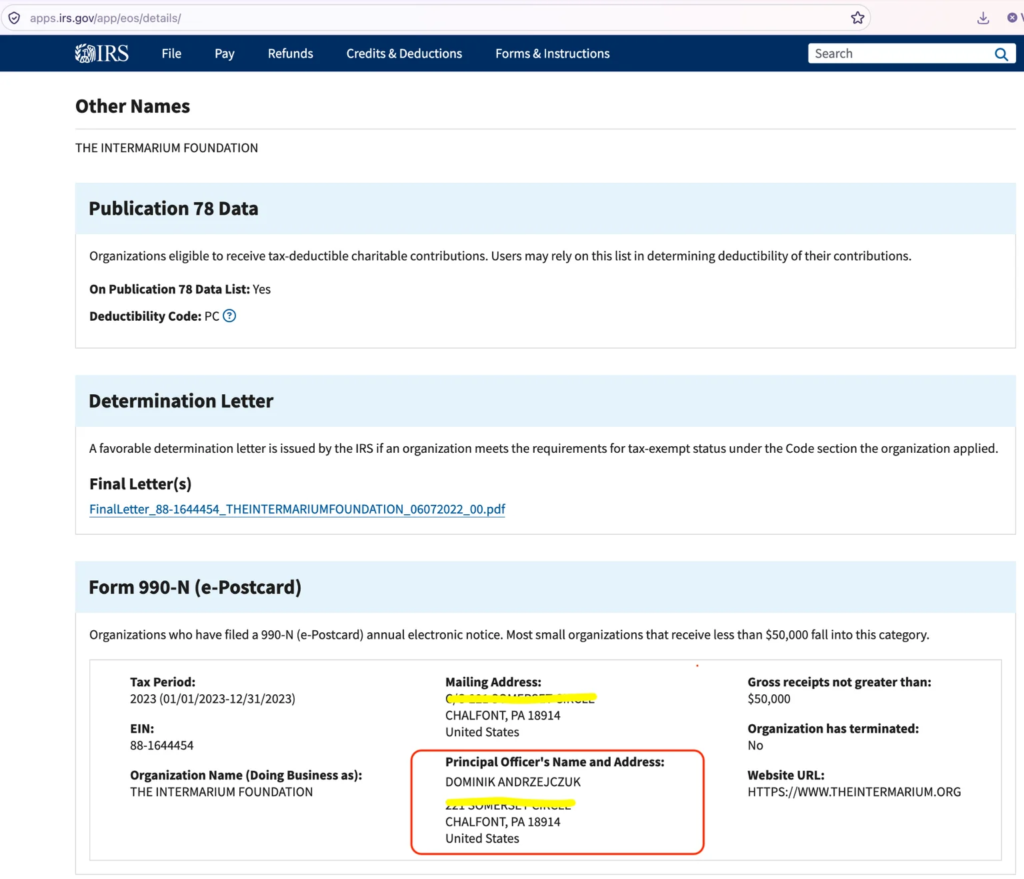
In the IRS filing we reviewed for the Intermarium Foundation, Dominik Andrzejczuk is listed as a “principal officer,” as shown in the screenshot below. On a LinkedIn page bearing his name (archived here), he is listed as a founder and board member of the foundation for the 2023–2025 term. On the same page, he is also listed as a “Global Partner” at Atmos Ventures, a company backed by the Polish Development Fund (archived here). The Polish Development Fund is a Polish state-owned financial institution that invests in startups.
In an interview with Le Monde in April 2025, Tompson stated that he had raised $800,000 from American donors. He also acknowledged that the Maccabee Task Force had covered the cost of plane tickets to Israel on two occasions, but denied that he had been paid to produce content or that Visegrád 24 was funded by the Israeli government. These statements must be distinguished from the grants documented in the tax returns.
The Maccabee Task Force is an organization founded in 2015 with the aim of countering the BDS (Boycott, Divestment, and Sanctions) movement at universities in the U.S. and Europe. Its website (archived here) states that the organization’s goal is to “bring about measurable changes in the way students perceive Israel,” while its co-director, Uriel Dison, told the newspaper Globes (archived here) that, following the events of October 2023, the organization is now bringing people to Israel, turning them into “war-time ambassadors.”
In the same Globes article, Dison refers to Tompson, saying: “He [Tompson] is coming back here [to Israel] next week and, with him, we’re going to produce 500 videos and content that show the face of Israel – from soldiers, to Nova festival survivors, Holocaust survivors, hostage families – nonstop videos that he’s going to blast. We hope these alone will reach between 200 million and 500 million views.”
According to a WIRED investigation (archived here), which was based on WhatsApp chats and emails reviewed by the magazine, Stefan Tompson participated in chat groups with wealthy individuals from Silicon Valley and members of the pro-Israel lobby in the U.S.
In the public sources we examined, we found no evidence of direct funding of Visegrád 24 itself by the Israeli or any other foreign government. On November 17, 2026, we also checked the public lists of active and archived filings in the FARA registry, for both organizations and individuals, without finding any filing under the names Visegrád 24, Intermarium Foundation, Stefan Tompson, or Alexandra Tompson (archived here). The fact that no record was found does not, in and of itself, prove the source of the funding.
The Bridges Partners documents filed with FARA in September 2025 describe an Israeli campaign involving paid influencers, called the “Esther Project” (archived here). The campaign plan does not name the influencers, nor does it mention Visegrád 24. These documents do not substantiate any connection between Visegrád 24 and the campaign. Overall, publicly available data do not make it possible to identify the original donors behind the bulk of the funding.
The funding data provide a framework for how the platform operates, but they do not, on their own, explain how the topics it covers are selected. To determine whether the November posts represent a new direction or a continuation of previous coverage, we reviewed Visegrád 24’s coverage of Cyprus over the past few years.
Visegrád 24 and Cyprus since 2020
A monthly search of Visegrád 24 articles mentioning Cyprus, the term “Cypriot,” or Nicosia, from January 2020 through November 2026, yielded 122 original articles: 6 in 2020, none in 2021, 15 in 2022, 4 in 2023, 18 in 2024, 14 in 2025, and 65 in 2026. Most of them contain news content. There was a particular spike in March 2026, with 38 posts about the drone attacks by Iran and Hezbollah against the British base at Akrotiri (RAF Akrotiri), such as the post from March 1 (archived here).
In the sample we examined, prior to October 2026, we identified three publications that referred to Cyprus as “occupied”: one marking the 50th anniversary of the invasion (archived here), on July 20, 2024, with 1,150 reposts, and two on June 29, 2025. One of the latter posts includes the phrase “Turkey LITERALLY occupies half of Cyprus” (archived here), with 1,101 shares.
In the material we collected, repeated references to the occupation are concentrated from October 2026 onward: a response to AJ+ (archived here) on October 15, 2026, and a response to RT (archived here) on October 23 are recorded. From that point on through November 18, approximately twelve similar posts were identified. The figures are based on samples collected using automated tools (web scrapers) and represent lower bounds. Since the total volume of posts from the account is unknown, we cannot calculate the percentage related to Cyprus.
The search was also extended to MiddleEast24, a second initiative of the Intermarium Foundation. The outlet launched in September 2025 with Israeli-American Dan Feferman as a co-founder, according to the foundation’s campaign page (archived here) and the Columbia Journalism Review (archived here).
The media outlet regularly covers topics related to Cyprus, with at least 38 articles published since September 2025, framing them within the context of an alliance between Greece, Cyprus, and Israel against Turkey. Examples include the post titled “Greece, Cyprus, and Israel Forge a Strategic Shield to Counter Mediterranean Threats” on August 29, 2026 (archived here) and Amichai Chikli’s call on August 10, 2026, for the formation of alliances with Greece and Cyprus (archived here). In the sample of MiddleEast24 posts we examined for November, we did not find any references to graffiti. The posts we recorded concern Turkey’s defense pact with Saudi Arabia and Pakistan, as well as Bilal Erdoğan’s visit to Lebanon.
The two media outlets were collaborating that week: posts by @middleast24 on Instagram on November 8 and 9, 2026 (archived here and here), which also appear on the Visegrád 24 profile, announce a joint broadcast with Feferman and Hayvi Bouzo.
The common organizational framework of the two media outlets, the collaboration between their teams, and their related subject matter help us understand the editorial context in which coverage of Cyprus takes place. It remains unclear, however, how this specific series of posts about graffiti came about: in the material we examined, we found no evidence of MiddleEast24’s involvement in promoting it, nor any source linking a specific funder to the coverage of Cyprus by either outlet.
In conclusion, Visegrád 24 combined the display of “Free Cyprus” graffiti with political statements on Cyprus and criticism of pro-Palestinian demonstrations. Its involvement with Cyprus, however, dates back to 2020. On the accounts that reposted the slogan, we identified identical messages and evidence of reused online identities: findings consistent with possible coordinated activity. However, there is no evidence of joint control over these accounts, their involvement in the creation of the visual content, or their coordination with Visegrád 24. The outlet has a conservative and pro-Israel orientation and is supported by the U.S.-based Intermarium Foundation. Public data make it possible to trace certain funding pathways, without revealing the original donors behind a large portion of the funds or linking a specific donor to the promotion of the Cypriot issue.
Note: The cover image was created using artificial intelligence. Artificial intelligence was used to translate some elements.